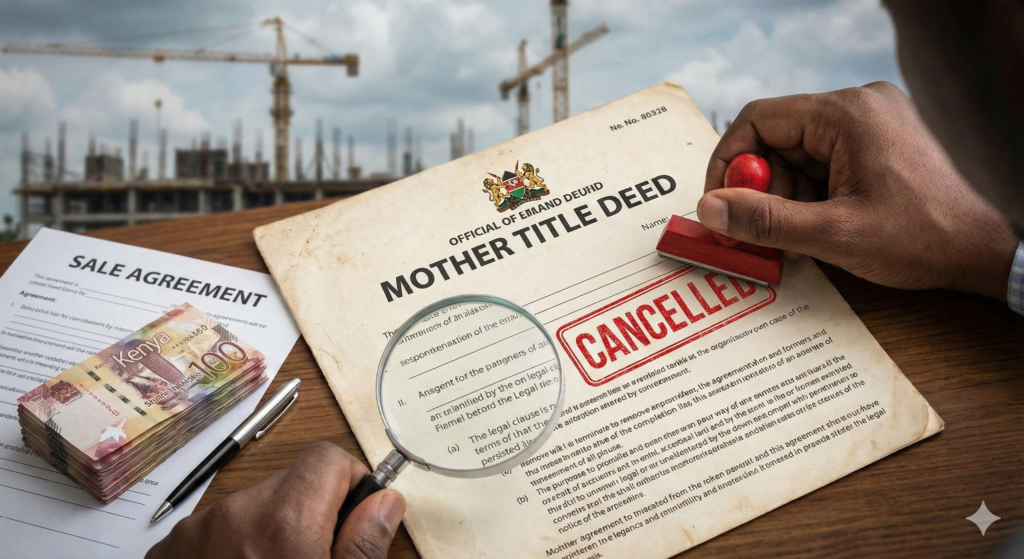
The “Mother Title” Risk: How to Verify Title Cancellation Before Paying Your Deposit
Are you about to pay a deposit for land in Kenya? Before you hand over your hard-earned money, there’s one critical verification step that could save you from becoming another victim of property fraud. The cancellation of the Mother Title is not just a formality; it’s your proof that individual title deeds can legally be issued.
Understanding the Mother Title in Kenya
In Kenya’s real estate landscape, the Mother Title refers to the original large parcel of land that a developer subdivides into smaller plots for sale. Think of it as the parent document from which all individual title deeds are born.
When a developer purchases a large tract of land, they hold one title deed covering the entire property. To sell individual plots, they must first subdivide this land through the Ministry of Lands and Physical Planning, creating multiple smaller parcels. Each of these parcels should eventually receive its own independent title deed, but this can only happen after the Mother Title is officially cancelled.
Why Mother Title Cancellation Matters
The cancellation of the Mother Title is the legal process that confirms subdivision has been completed and individual titles can now be issued. Without this crucial step, you’re essentially buying a promise rather than a legally defined piece of property.
Real Consequences for Kenyan Buyers
Across Kenya, from Nairobi’s suburbs to coastal towns like Mombasa and Kilifi, countless buyers have lost millions of shillings due to uncancelled Mother Titles. Common scenarios include:
- Developers disappearing with deposits before completing subdivision
- The same plot being sold to multiple buyers since individual boundaries aren’t legally defined
- Banks using the Mother Title as collateral, leaving all plot buyers at risk if the developer defaults
- Delays spanning 5 to 10 years in receiving individual title deeds
- Discovery that the Mother Title was charged to financial institutions without disclosure
Step-by-Step Verification Process
1Request the Mother Title Number
Ask the developer or seller to provide the original Mother Title number. They should provide this information willingly. If they hesitate or refuse, consider this a red flag.
2Conduct an Official Search at the Lands Registry
Visit the relevant Land Registry office (based on where the property is located) or use the online Ardhi Management Information System (Ardhi MIS) if available in your county. Request an official search of the Mother Title number. This search will reveal:
- Current status of the Mother Title
- Whether it has been cancelled
- If there are any encumbrances, charges, or caveats
- The registered owner’s details
3Verify the Subdivision Approval
Request to see the approved subdivision plan from the Physical Planning Department. This document shows how the original parcel was divided and should include your specific plot number with defined boundaries and measurements.
4Confirm Individual Title Deed Availability
If the Mother Title shows as cancelled, verify that individual title deeds have been or can be issued. Request the specific title number for your plot and conduct a separate search to confirm:
- The title exists in the registry system
- It matches your plot number and size
- There are no adverse entries like caveats or charges
5Engage a Licensed Advocate
Never skip this step. A qualified property lawyer in Kenya will conduct comprehensive due diligence, including verifying cancellation status, reviewing all documentation, checking for hidden encumbrances, and ensuring the sale agreement protects your interests.
Documents You Must Inspect
Red Flags That Should Stop You Immediately
Halt the transaction if you encounter any of these warning signs:
- Developer refuses to provide the Mother Title number
- Mother Title search shows it’s still active and not cancelled
- The Mother Title has a charge or caveat registered against it
- Developer pressures you to pay before verification is complete
- Individual title deeds are “in process” for more than 12 months
- The developer offers to hold your title deed “for safekeeping”
- Documentation shows inconsistencies in plot numbers or sizes
- Seller cannot produce original documents, only photocopies
Using Kenya’s Ardhi MIS for Verification
The Ministry of Lands has introduced the Ardhi Management Information System to digitize land records and make searches more accessible. Here’s how to use it effectively:
Access the system through your county’s land registry offices or authorized service providers. You’ll need to create an account and pay the official search fee, typically between KES 500 to 1,000. The system allows you to search by title number, plot number, or owner’s name.
✓ Pro Tip: Always conduct both an online search and a physical verification at the Land Registry. While Ardhi MIS is improving, some records may not be fully updated in the digital system. Cross-verification provides the highest level of certainty.
What Questions Should You Ask the Developer?
Before committing to any deposit, have a direct conversation with the developer and ask these critical questions:
- Has the Mother Title been cancelled? Request documentary proof, not just verbal confirmation.
- When was the subdivision approved? Recent approvals may indicate titles are still being processed.
- Are individual title deeds ready for issuance? If not, what’s the exact timeline and what delays might occur?
- Is there any charge or encumbrance on the Mother Title? This could affect your plot even after subdivision.
- Can I see recent searches from other buyers? Legitimate developers should have multiple recent searches available.
- What happens to my deposit if title issues arise? Ensure refund terms are clearly written in your agreement.
The Legal Framework in Kenya
Understanding your legal protections helps you make informed decisions. In Kenya, property transactions are governed by several key pieces of legislation:
The Land Registration Act, 2012 governs the registration of land rights and provides the framework for title issuance. The Land Act, 2012 addresses land administration and management. The Physical and Land Use Planning Act, 2019 regulates subdivision and land use planning.
Under these laws, developers are legally required to complete the subdivision process and cancel the Mother Title before selling plots. Failure to do so while collecting payments can constitute fraud under the Penal Code.
Cost of Verification in Kenya
Protecting your investment through proper verification is remarkably affordable compared to the risk of losing your deposit. Here’s what to budget for:
- Official Land Search: KES 500 – 1,000 per search
- Physical Planning Department Verification: KES 500 – 2,000
- Legal Fees for Due Diligence: KES 20,000 – 50,000 depending on property value
- Survey Verification (optional but recommended): KES 15,000 – 40,000
Total investment in verification: approximately KES 36,000 – 93,000. Compare this to typical land deposits of KES 200,000 to several million shillings, and the cost-benefit analysis is clear.
🔑 Key Takeaways for Kenyan Property Buyers
Never pay a deposit before confirming Mother Title cancellation. Conduct official searches at the Land Registry, not just online checks. Engage a qualified lawyer for all land transactions regardless of the amount. Verify that individual title deeds exist or can be legally issued. Be willing to walk away if verification reveals problems. Remember that legitimate developers welcome scrutiny and transparency.
Taking Action: Your Next Steps
Now that you understand the importance of Mother Title verification, here’s your action plan:
Before paying any deposit, request all documentation from the seller including Mother Title details and subdivision approvals. Visit the relevant Land Registry office with the Mother Title number and conduct an official search. Engage a licensed advocate who specializes in conveyancing to review all findings. If everything checks out and the Mother Title is cancelled, proceed with confidence knowing you’ve protected your investment.
If verification reveals problems, thank yourself for doing due diligence and continue your property search elsewhere. There are many legitimate developments in Kenya with properly cancelled Mother Titles and ready individual deeds.
Protect Your Property Investment Today
Don’t let your dream of land ownership turn into a nightmare. Our team of experienced property consultants and legal experts can help you verify Mother Title cancellation and conduct comprehensive due diligence for any property in Kenya.
Frequently Asked Questions
How long does Mother Title cancellation take in Kenya?
Once all approvals are in place, the actual cancellation process can take 3 to 6 months. However, the entire subdivision process from application to cancellation typically takes 12 to 24 months, depending on the county and complexity of the subdivision.
Can I pay a deposit before Mother Title cancellation if the developer provides a guarantee?
While some reputable developers offer this option with proper legal safeguards, it carries inherent risk. If you choose this route, ensure your lawyer drafts an ironclad agreement with clear refund terms, escrow arrangements, and timeline commitments.
What if the Mother Title was cancelled years ago but I can’t find my individual title?
This situation requires immediate investigation. Conduct a search using your plot number to determine if a title was ever issued, check if there are processing delays at the registry, or determine if there are undisclosed issues preventing issuance. Your lawyer should pursue this actively with the Land Registry.
Is it safe to buy land in upcoming areas where subdivision is recent?
Yes, if proper verification is done. Newer subdivisions can be excellent investments. The key is ensuring all legal processes are complete, not just trusting the developer’s timeline. Always verify independently.
Conclusion: Knowledge is Your Best Protection
The Kenyan real estate market offers tremendous opportunities for wealth creation and homeownership. However, these opportunities come with responsibilities. Verifying Mother Title cancellation before paying your deposit is not optional; it’s essential due diligence that protects your financial future.
Remember that legitimate sellers and developers will never pressure you to skip verification steps. If someone tries to rush you past this crucial checkpoint, they likely have something to hide. Your instinct to verify is not mistrust; it’s wisdom.
Take control of your property purchase journey by demanding transparency, conducting thorough searches, engaging qualified professionals, and being willing to walk away from questionable deals. Your future self will thank you for the diligence you exercise today.
Start your property verification today. Download our comprehensive property due diligence checklist and connect with our network of verified advocates across Kenya. Your dream property awaits, and with the right verification process, you can claim it with complete confidence and legal certainty.